Life As A Worm
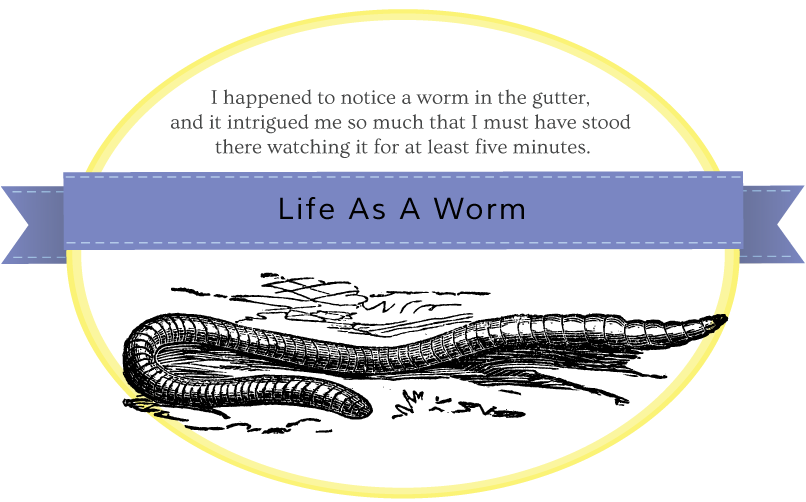
Several years ago as I was walking home from work I happened to notice a worm in the gutter and it intrigued me so much that I must have stood there watching it for at least five minutes.
At first I thought it was such a stupid worm that it couldn’t tell its head from its tail. I tried to imagine the conversation it was having with itself, but then I just gave in and I watched the drama unfold. I think this worm was trying to get home but it was lost.
For the sake of this story, I am going to call the head of the worm Herbert and its tail Henry. Herbert thought home was north and headed in that direction while Henry thought it was south and started in that direction.
If you are following the story you realize that Herbert and Henry faced a conundrum leading to nowhere. As I watched this worm I realized that both ends were stubborn and not willing to compromise. Both continued to pull in separate directions. I was fascinated watching this four-inch worm stretch itself into an eight-inch worm.
Both Herbert and Henry were pulling mightily without making any progress. That’s when Mother Nature stepped in to stop them from pulling themselves apart. When they reached the limit of their stretch, they were pulled back to their original four-inches, stopping at the exact place where they started.
Remember Herbert and Henry were both stubborn. Mother Nature tried to help them understand that neither was going anywhere unless they stopped and worked together. However, they wouldn’t listen and for the entire five minutes neither would give a worm’s inch.
The next day when I walked home along the same route, Herbert and Henry were gone. I don’t know if they made it home, dried up in the sun, or were eaten by a bird.
This simple illustration emphasizes the importance of teaching our children the resiliency skills of cooperation and comprise as an appropriate remedy for most stalemates.
Share This Article:[sgmb id=1]
Anne's Corner
“He took my …” “She always gets her way!” “That’s not fair!” Every parent is all too familiar with such squabbles: two children want the same toy or the same seat, each wants a different show or a different game. It can be so frustrating to constantly play referee. There is another way that works better and will teach your child become a skilled negotiator of effective compromise. When they are calm, proactively teach the pattern and have them role-play common scenarios. The first few times they try this in a real situation, it’s probably a good idea to supervise them. After that, stay out of the middle (unless there is threat of harm). Here’s the pattern: 1. When there is a conflict, call for a pause. Take reaching a solution off the table for a few moments. 2. Tell the children that there will be no toy, or show, or __________ until they each listen as the other explains what they want and why. 3. Only then can they suggest solutions, and they need to be able to explain why their suggestion works for them and also why they think it would work for the other person, taking into account what the other one told them in step 2. Again, this is between them. They tell each other and listen to each other, not to you. Once they learn the pattern, stay out of the middle! 4. The children come back to you once they have agreed on a solution and can explain to you how it works for both of them. It is so great to step out of the struggle and to know that you have helped your child establish a pattern for facing whatever conflicts come their way more resiliently throughout their life.
Anne's Corner
“He took my …” “She always gets her way!” “That’s not fair!” Every parent is all too familiar with such squabbles: two children want the same toy or the same seat, each wants a different show or a different game. It can be so frustrating to constantly play referee. There is another way that works better and will teach your child become a skilled negotiator of effective compromise. When they are calm, proactively teach the pattern and have them role-play common scenarios. The first few times they try this in a real situation, it’s probably a good idea to supervise them. After that, stay out of the middle (unless there is threat of harm). Here’s the pattern: 1. When there is a conflict, call for a pause. Take reaching a solution off the table for a few moments. 2. Tell the children that there will be no toy, or show, or __________ until they each listen as the other explains what they want and why. 3. Only then can they suggest solutions, and they need to be able to explain why their suggestion works for them and also why they think it would work for the other person, taking into account what the other one told them in step 2. Again, this is between them. They tell each other and listen to each other, not to you. Once they learn the pattern, stay out of the middle! 4. The children come back to you once they have agreed on a solution and can explain to you how it works for both of them. It is so great to step out of the struggle and to know that you have helped your child establish a pattern for facing whatever conflicts come their way more resiliently throughout their life. 