The Puzzle: Life’s Metaphor
When I was a little boy I lived in the small town of Afton, Wyoming. At the time I was living there, Afton was a place where keys were left in the cars, doors remained unlocked, and it was safe to leave young children home. Such was the case when this adventure took place.
On this particular day my mother had to go to town, and she was comfortable leaving my two cousins (Roger and Gary) and me alone without having to worry about our safety. We were five years old. While it was true that she didn’t need to worry about our safety, it was not true that we were safe from our own mischief.
After she left, someone came up with an idea that was readily approved and acted upon by all. We decided that it would be fun to pile all the furniture in the house against the front door and not let Mom in when she returned home, which is exactly what we did. We piled our couch, table, chairs, beds, and whatever else was in the house up against the door. We also added to the mess by throwing all of our puzzles, books, papers, and whatever else we could find around the room.
After completing our project, we realized we made a mistake. We had forgotten to barricade the back door. We knew that she would be home soon and unfortunately all we had left for the back door was the refrigerator and the old ringer washing machine.
Shortly after finishing with the back door, the greatly anticipated arrival of Mom became reality. She went to the front door, turned the knob, and pushed but it wouldn’t open. Three sets of eyes were glued to the window watching her struggle and laughing at her because she couldn’t get in. She looked into those eyes and told us to let her in and three little heads shook, telling her “No”. Then we laughed harder.
To assume that she was upset by our behavior would be an accurate assumption. She walked down the front steps and headed to the back door. By the time she reached the back door her adrenaline was pumping and at that moment I thought she could have lifted a car. When she reached the door, she pushed, and we pushed, and we lost. My cousins were sent home, and I don’t remember what happened to me other than sitting on the front room floor, crying, and putting puzzles together.
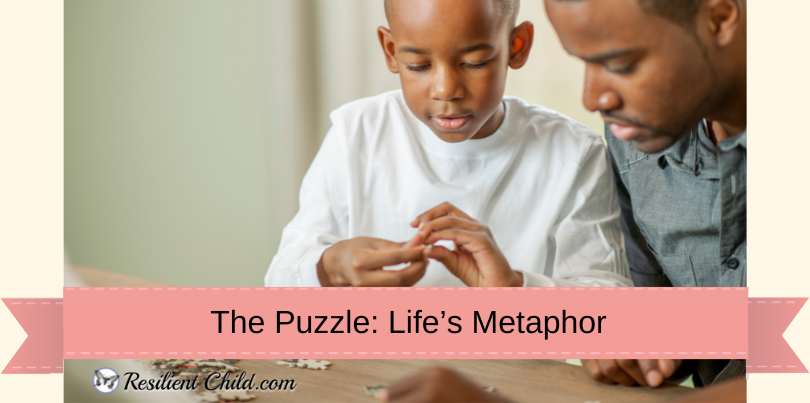
As I discussed this story with a friend of mine, he pointed out that sitting on the floor putting puzzles together could be used as a metaphor for life. Each piece of the puzzle was part of a plan that when combined with the other parts it formed a picture. Without all the pieces the picture would be incomplete and the goal of putting the puzzle together would not be realized.
The particular puzzle I was putting together was simple and meant for young children. Developmentally it could help a child with memory, eye hand coordination, identification and placement of different shapes, problem solving, etc. To reap the benefits provided by the puzzle it had to be put together correctly with all the pieces in their proper place.
Other puzzles are much more complicated and require different skills and are more appropriate as people get older. But the principles of completing the puzzle are the same in both the simple as well as the more complex.
When I was five, sitting by myself, crying, and putting simple puzzles together they were challenging and required a five-year-old skill level. The same is true of our life’s challenges. When we are five, we have the knowledge and skill of a five-year-old. The challenges of the five-year-old may seem overpowering but like putting the puzzle together piece-by-piece he can develop the ability to recognize his challenges and deal with them more effectively.
As we mature, we develop the skills to put more challenging and complex puzzles together that would have been impossible as a young child. Based on our developmental age the challenges are great for both puzzles. In fact, both the five-year-old boy as well as the fifteen-year-old teenager can be more efficient completing the puzzle with help.
As a five-year-old boy my mother provided the guidance and help for me to meet my challenges by letting me know that she loved me even though I had to be disciplined. As I grew older and entered my teenage years, she was still with me to provide encouragement, guidance, and extra eyes to help me put my personal life puzzle together.
The pieces in both puzzles represent life’s challenges and opportunities for personal growth. They become more difficult and more complicated as we get older but through diligence and the help of loving parents, understanding friends, compassionate teachers, loyal mentors, and others we can identify the puzzle pieces, pick them up, and place our challenges into our own puzzle and grow and become stronger from it.
Happy Failing Forward,
Calvert Cazier
PS Want to help your kids have less stress and more success at home and school? CLICK HERE to get a copy of our book, The Resiliency Toolkit: A Busy Parent’s Guide to Raising Happy, Confident, Successful Children.
Share This Article:[sgmb id=1]
